

By Dr. Christopher Bingham, DDS, MS | Board-Certified Periodontist | Council Oak Perio, Austin, TX
Gum graft recovery follows a predictable path. The first three days bring the most discomfort and swelling. Days four through seven show steady improvement. By the end of the second week, most patients eat comfortably again. The tissue integrates over the first month, and the graft matures to its final color over three to six months.
Knowing this timeline removes most of the anxiety around the procedure. When you understand what each day should look like, you can tell normal healing from a genuine problem, and you can plan your week with confidence. At Council Oak Perio in Austin, TX, Dr. Christopher Bingham uses a specific protocol, built around platelet-rich fibrin and a custom stent, to make recovery more comfortable than the traditional experience most online guides describe. This post walks you through recovery day by day and explains how that protocol changes it.
A note before we begin: these are general expectations. Dr. Bingham gives every patient specific instructions for their case, and those instructions always take priority over any general guide.
Learn more: Gum Graft Surgery- Cleveland Clinic
Most gum graft discomfort does not come from the grafted area. It comes from the donor site, the place tissue is taken from.
In a traditional connective tissue graft, the surgeon removes tissue from the roof of the mouth, leaving an open wound on the palate. That wound is what most patients find hardest. It sits where the tongue touches constantly, and every swallow and every meal makes contact. Search the web for gum graft recovery, and you will find article after article describing the palate as the worst part.
Dr. Bingham's protocol targets this problem directly, using two tools that set our recovery apart.
Platelet-rich fibrin (PRF). We draw a small sample of your blood, concentrate its natural healing factors, and place that concentrate at the donor site. PRF speeds soft tissue healing and helps control bleeding, drawing on your own biology to close the wound faster.
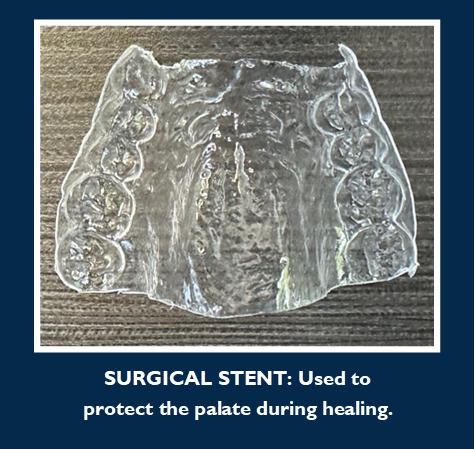
A custom surgical stent. Before surgery, we make an appliance that fits over your palate like a retainer. It shields the donor site from your tongue, your food, and the air while the tissue heals. You wear it through the first two weeks, the window when the palate would otherwise be most raw. We leave the front teeth open, so nothing shows when you smile.
For patients who need many teeth treated, or who would rather avoid a palate wound entirely, Dr. Bingham can use donor graft tissue instead, which removes the second surgical site altogether.
Learn more: Gum Recession Treatment at Council Oak Perio

These first three days are the most important for the graft and the most uncomfortable for you. The graft is fragile and establishing its first connection to the tissue beneath it. Protect it.
What to expect. Swelling builds and usually peaks around 48 to 72 hours, then begins to fall. Discomfort follows the same curve. Minor bleeding or a pink tint to your saliva is normal on the first day.
What to do.
What the stent does here. This is the window when the palate would hurt most. The stent covers it, so eating and swallowing cause far less irritation than the recovery you may have read about.
The worst is behind you. Swelling recedes, discomfort fades, and the graft begins healing to the surrounding tissue.
What to expect. You will feel noticeably better each day. The graft may look white, yellowish, or lumpy. This is normal healing, not infection: it is a protective layer of tissue forming, and the contour smooths over the following weeks.
What to do.
By the second week, most patients begin to feel close to normal. The graft is stable, and the donor site, protected by the stent, has largely closed.
What to expect. Daily discomfort has usually resolved. The graft still looks different from the surrounding gum, redder or paler, but it is integrating well. Most patients return to a fairly normal diet by the end of this week.
What to do.
Most patients have a follow-up visit around day 10 to 14 so Dr. Bingham can check healing and, if needed, remove sutures.
By now, recovery is largely complete. The initial healing phase has finished, and the graft is well on its way to full integration.
What to expect. Everyday discomfort is gone. The graft's color begins shifting toward a healthier pink that better matches the surrounding tissue, and its surface toughens from fragile new tissue into a durable one. Normal eating resumes for most patients.
What to do.
The graft continues to mature quietly for several months. Its color and texture keep refining until it blends fully with the gum around it. You will not feel this stage; it happens on its own.
The result is the point of the entire procedure: exposed roots covered, sensitivity gone, and the gumline restored and protected for the long term.
Learn more: Gum Recession Treatment: Every Option Explained
Most of what looks alarming during recovery is normal, including a white or yellow film over the graft and a graft that looks lumpy at first. Still, call the office if you notice any of the following:
Dr. Bingham makes himself available to patients after surgery. When something concerns you, ask. That is what we are here for.
How long does gum graft recovery take? The uncomfortable part is brief. The first three days are the peak, most patients feel much better within a week, and most return to normal eating by the end of the second week. The graft then matures over three to six months, though you will not notice that final stage. Most people take only a day or two off work.
How painful is a gum graft, really? Less than most patients expect. The grafted area itself is often numb; the discomfort usually comes from the palate donor site. Because Dr. Bingham protects that site with platelet-rich fibrin and a custom stent, our patients typically report far less palate pain than standard recovery guides describe. Most manage with over-the-counter pain relievers.
What can I eat after a gum graft? For the first three days, cool or lukewarm foods that need no chewing: yogurt, applesauce, smoothies by spoon, broth, mashed potatoes. Days four through seven, add soft solids like scrambled eggs and well-cooked pasta. Avoid hot, crunchy, spicy, and acidic foods for at least two weeks. Never use a straw during early healing.
When can I brush and floss the graft site? Keep brushing the rest of your mouth normally, but avoid the surgical area until Dr. Bingham clears it, usually a few weeks in. Do not floss, use a water flosser, or use interdental brushes near the graft until he approves. Disturbing the site too early is the most common cause of graft complications.
Is the white color on my graft normal? Usually, yes. A white or yellowish film over the graft is typically a normal layer of healing tissue, not infection. The graft may also look lumpy at first, then smooth out over several weeks. If you are unsure whether what you see is normal, call us; we would rather reassure you than have you worry.
If you are considering a gum graft, or you have one scheduled and want to know what recovery really involves, we are glad to walk you through it.
Dr. Christopher Bingham is a board-certified periodontist with over 20 years of experience whose protocol is built to make gum grafting as comfortable as possible. Not a chain. Not a franchise. Just a specialist and his team, right here in Central Austin since 2013.
📞 512-453-1600
711 W. 38th St. Suite G5 · Austin, TX 78705
This blog post has been reviewed, edited, and approved by Dr. Christopher Bingham, board-certified periodontist, Austin, Texas.
Saving teeth when we can. Replacing teeth when we must. Creating confident, healthy smiles.