
By Dr. Christopher Bingham, DDS, MS | Board-Certified Periodontist | Council Oak Perio, Austin, TX
If you've noticed your gums pulling back, your teeth looking longer, or a twinge of sensitivity when you drink something cold, you have options — and not all of them involve surgery. Gum recession treatment ranges from simple monitoring and desensitizing care for the mildest cases, to gum grafting procedures that cover exposed roots and rebuild the gumline for more advanced recession.
The right treatment depends on three things: how far the recession has progressed, what's causing it, and whether it's affecting your comfort, your tooth's health, or your confidence in your smile. At Council Oak Perio in Austin, TX, Dr. Christopher Bingham, a board-certified periodontist with over 20 years of experience, evaluates each of these factors before recommending anything — because the goal is always to do what your situation actually requires, no more and no less.
This guide walks through every gum recession treatment option, when each one makes sense, and how to choose the right one for you.
Gum recession is the process in which the margin of gum tissue surrounding a tooth wears away or pulls back, exposing more of the tooth or its root. It's one of the most common dental problems — and one of the most overlooked, because it happens so gradually that most people don't notice until they see it in the mirror one day.
Left untreated, recession is not just a cosmetic concern. Exposed tooth roots are softer than enamel and far more vulnerable to decay. As a recession progresses, the supporting tissue and bone around the tooth can be damaged, which, in the most advanced cases, can lead to loose teeth or tooth loss. Recession also tends to worsen over time if the underlying cause isn't addressed.
The encouraging news: when caught and treated appropriately, gum recession is very manageable. Catching it early often means a simpler, less invasive treatment — which is exactly why understanding your options now matters.
Learn more: Gum Recession in Austin, TX
For very mild recession that isn't causing symptoms or progressing, the first step isn't a procedure at all — it's identifying and correcting whatever is causing the recession in the first place. Treating the gumline without addressing the cause simply sets the stage for recession to return.
Common causes Dr. Bingham looks for include:
When recession is mild, treatment is not always required. Sometimes, monitoring the area closely over time, paired with eliminating the cause, is often the most appropriate first step. This is the conservative, evidence-based approach: intervene surgically when it's warranted, not before.
If your primary complaint is sensitivity from exposed roots — that sharp response to cold water, cold air, or brushing — and the recession itself is mild, desensitizing treatments can manage the discomfort.
These include prescription-strength fluoride gels, desensitizing toothpastes, and in-office treatments that seal and protect the exposed root surface. It's important to understand what these treatments do and don't do: they address the symptom of sensitivity, but they do not restore lost gum tissue or stop recession from progressing. For many patients with mild recession, that's enough. For others, sensitivity is the early signal that a more definitive solution is worth considering.
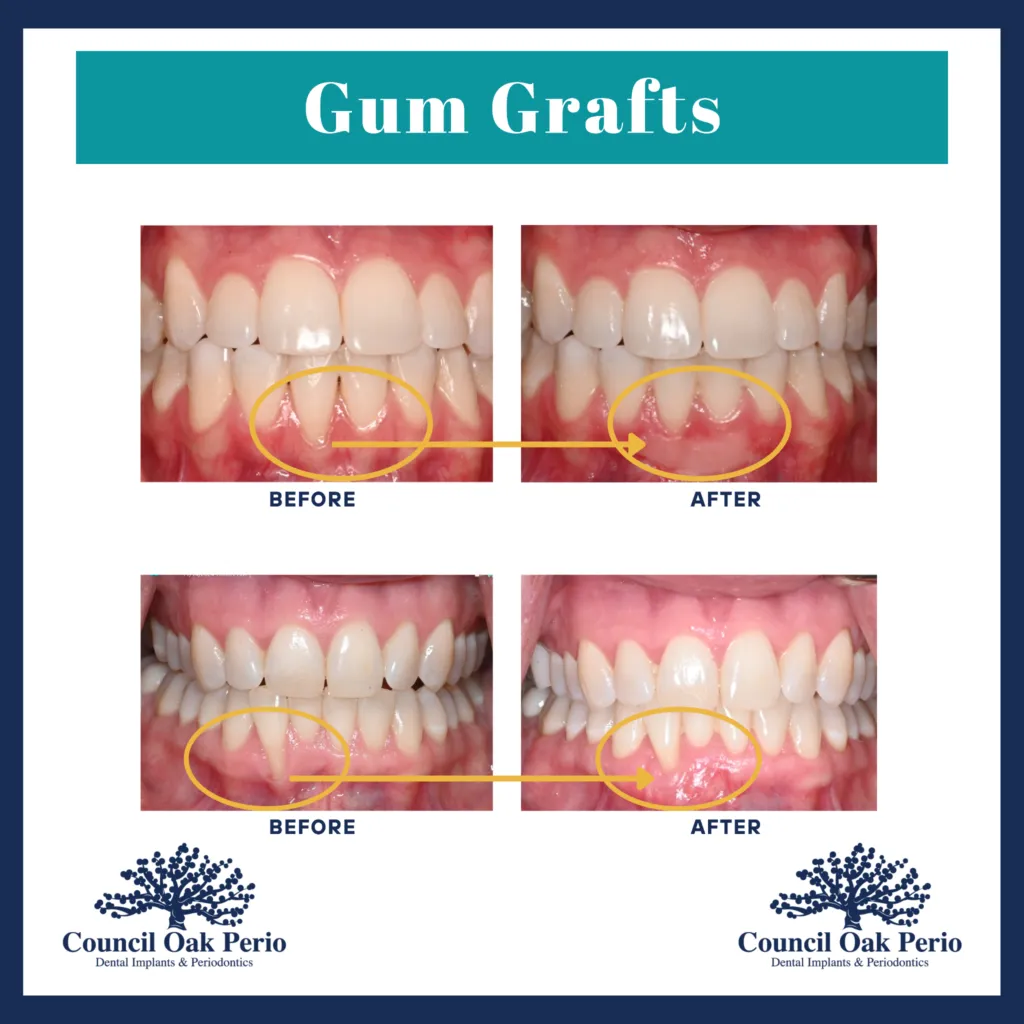
When recession is moderate to advanced, has exposed significant root surface, or is threatening the long-term health of the tooth, a gum graft is the gold-standard treatment. A soft tissue graft restores the gumline by covering exposed roots, which protects the tooth from further damage, reduces sensitivity, and improves the appearance of the smile.
There are two main goals a graft can accomplish — root coverage, and thickening or strengthening thin gum tissue — and Dr. Bingham uses different techniques depending on which goals apply to your case.
This is the most common and most predictable type of soft tissue graft. In this technique, a small piece of connective tissue is taken from beneath the surface of the palate (the roof of the mouth) and placed at the recession site, between the bone and the overlying gum tissue. It accomplishes both goals at once: covering the exposed root and thickening the tissue. Research consistently identifies the connective tissue graft as the benchmark against which other root-coverage techniques are measured, particularly for achieving a strong, natural color match and durable coverage.
In this technique, gum tissue is placed on the outer surface of the gums rather than tucked beneath. Dr. Bingham typically uses this approach in the lower front region of the mouth, where the goal is often to thicken and strengthen thin gum tissue and create a stable, attached band of gum that resists further recession.
For patients who need many teeth treated, or who would prefer to avoid taking tissue from their own palate, Dr. Bingham can use carefully processed, fully vetted donor graft material instead. This acts as a scaffold for your own cells to integrate, achieving excellent results while eliminating the discomfort of a palatal donor site. When a patient's treatment needs are extensive, this is often the preferred path.
Learn more: Gum Graft Surgery at Council Oak Perio
A common reason patients delay gum grafting is fear of discomfort — particularly at the palate, where tissue is harvested. Dr. Bingham's protocol is specifically designed to minimize this.
He uses platelet-rich fibrin (PRF) — a concentrate made from a small sample of your own blood — placed at the donor site. PRF accelerates soft tissue healing and helps control bleeding, drawing on your body's own growth factors to speed recovery. This reflects a broader trend in periodontology toward using the body's own biology to improve graft outcomes.
To protect the palate while it heals, patients are given a custom surgical stent — similar to a clear retainer, with two modifications: the front teeth are left open so any bleeding doesn't show at the front of the smile, and the stent covers and shields the tender palate. Patients wear it for the first two weeks of healing.
For patients who feel anxious about the procedure itself, sedation options are available, from nitrous oxide to oral conscious sedation to twilight IV sedation. The right choice depends on your level of anxiety and the extent of treatment.
The result of this combined approach is real: as one of Dr. Bingham's gum graft patients, Jennifer, described after her treatment — being able to smile at everyone again left her feeling genuinely confident and more social than before. That's the actual goal of treatment. Not just covering a root, but giving someone their confidence back.
Learn more: Sedation Options at Council Oak Perio
You may have read about the "pinhole" surgical technique, in which instruments are inserted through a tiny entry point to loosen and reposition existing gum tissue over exposed roots, with collagen added to stabilize it and no stitches required. It's an appealing idea, and for carefully selected cases with adequate existing tissue, minimally invasive tunneling approaches can produce good results.
It's important to be clear-eyed about the limitations, though. These techniques aren't ideal for every case — they require adequate native gum tissue and specific defect characteristics to work well. And the research is consistent on one point: the connective tissue graft combined with a coronally advanced flap remains the gold-standard procedure for predictable root coverage, the benchmark that newer techniques are measured against.
The right approach is the one matched to your specific anatomy and goals — which is exactly what a thorough evaluation determines. Choosing a technique because it sounds easier, rather than because it fits the case, is how patients end up needing treatment twice.
The honest answer is that you can't know for certain from an article — and you should be cautious of any provider who recommends a specific procedure before examining you. The appropriate treatment depends on measurements and findings that require an in-person evaluation:
At Council Oak Perio, Dr. Bingham takes the time to assess each of these and explain what he finds — so you understand not just what he recommends, but why. Some patients leave with a recommendation for a graft. Others leave reassured that monitoring and a change in brushing technique is all they need right now. Both are good outcomes, because both are honest.
Can receding gums grow back on their own?
No. Gum tissue that has receded does not grow back or regenerate on its own. However, recession can often be stopped from progressing by addressing its cause, and lost tissue can be restored through gum grafting. This is why early evaluation matters — the sooner the cause is addressed, the less tissue is lost.
Do I always need surgery for gum recession?
Not at all. Very mild recession that isn't progressing and isn't causing symptoms can often be managed by correcting the cause — such as switching to gentler brushing — and monitoring the area over time. Surgery (a gum graft) becomes the right option when recession is moderate to advanced, is exposing root surface, or is threatening the tooth's long-term health.
How much does gum recession treatment cost?
Cost depends entirely on the treatment needed — monitoring and desensitizing care is minimal, while gum grafting is a surgical procedure with a corresponding fee that varies based on the number of teeth treated and the technique used. Many dental insurance plans provide some coverage for gum grafting when it's medically necessary.
Is a gum graft painful?
Most patients report far less discomfort than they expected. The procedure is performed under local anesthesia, with sedation available for anxious patients. Dr. Bingham's use of platelet-rich fibrin (PRF) and a custom palatal stent is specifically designed to minimize discomfort at the donor site and speed healing. Most patients manage recovery with over-the-counter pain relievers.
How long does it take to recover from a gum graft?
Initial healing typically takes one to two weeks, during which you'll wear a protective stent if tissue was taken from your palate, and eat soft foods. Most patients return to work within a day or two. Full tissue maturation continues over several weeks. We provide detailed aftercare instructions and remain available throughout your recovery.
When should I see a periodontist about gum recession?
If you've noticed your teeth looking longer, increased sensitivity to hot or cold, a notch or step where the tooth meets the gum, or visible recession on one or more teeth, it's worth having a periodontist evaluate it. A periodontist specializes specifically in the gums and supporting structures of the teeth, and can tell you whether your recession needs treatment now or simply monitoring.
If your gums have been receding, your teeth feel sensitive, or you simply want to know whether the recession you've noticed needs treatment — we're here to help you find out.
Dr. Christopher Bingham is a board-certified periodontist with over 20 years of experience who takes the time to explain exactly what's happening and what your real options are. Not a chain. Not a franchise. Just a specialist and his team, right here in Central Austin since 2013.
Schedule Now
📞 512-453-1600
711 W. 38th St. Suite G5 · Austin, TX 78705
This blog post has been reviewed, edited, and approved by Dr. Christopher Bingham, board-certified periodontist, Austin, Texas.
Saving teeth when we can. Replacing teeth when we must. Creating confident, healthy smiles.
References: