
By Dr. Christopher Bingham, DDS, MS | Board-Certified Periodontist | Council Oak Perio, Austin, TX
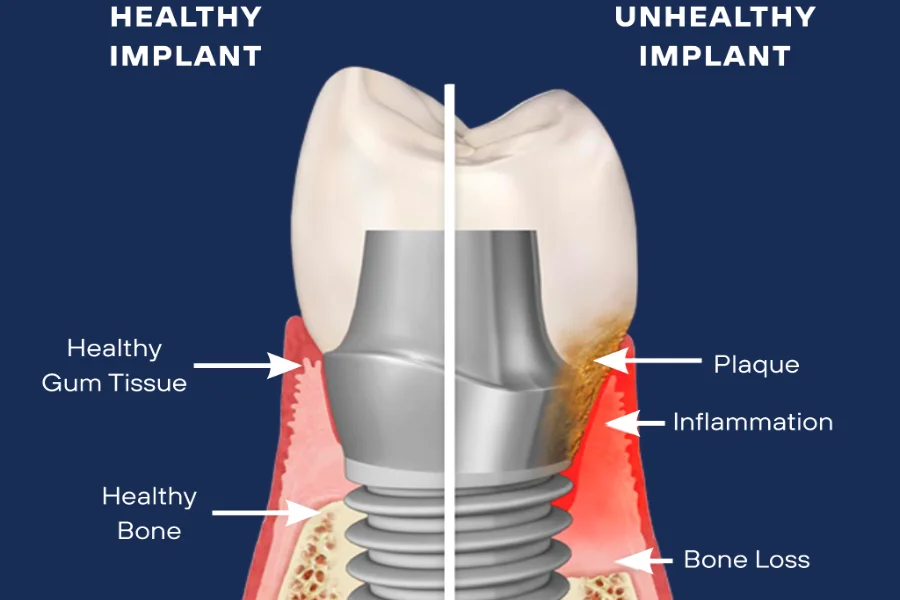
Peri-implantitis is, in the simplest terms, gum disease around a dental implant. It's a bacterial infection of the tissue surrounding an implant that, if left untreated, destroys the supporting bone and can ultimately cause the implant to fail. Just as periodontal disease threatens natural teeth by attacking the bone that holds them, peri-implantitis threatens implants the same way — which is why protecting your implant is fundamentally about controlling bacteria and inflammation, exactly as you would to protect your natural teeth.
The encouraging news is that peri-implantitis is largely preventable, and its earlier stage is reversible if caught in time. At Council Oak Perio in Austin, TX, Dr. Christopher Bingham, a board-certified periodontist with over 20 years of experience, both places dental implants and treats the gum and bone conditions that threaten them — which means implant patients here are cared for by a specialist who understands both sides of the equation.
This post explains what peri-implantitis is, the warning signs to watch for, its causes, how it's treated, and — most importantly — how to protect your implant investment for the long term.
Peri-implant disease develops in two stages, and the difference between them is critical.
Peri-implant mucositis is the early, reversible stage. Here, the soft tissue around the implant becomes inflamed — red, puffy, and prone to bleeding — but the bone supporting the implant has not yet been affected. This is the implant equivalent of gingivitis. Caught at this stage, it can be fully resolved with professional cleaning and improved home care, and the implant remains completely stable.
Peri-implantitis is the advanced stage. The inflammation has progressed beyond the soft tissues and is now destroying the bone that supports the implant. This is the implant equivalent of periodontitis, and, like periodontitis, the bone loss it causes cannot be fully reversed. The infection can be stopped and the implant often saved, but any bone already lost is difficult to recover.
The takeaway mirrors what we tell patients about natural teeth: the earlier this is caught, the better the outcome. Mucositis is a warning you can act on. Peri-implantitis is damage you're trying to contain. The goal is to catch trouble at the mucositis stage — which is entirely possible with regular monitoring.
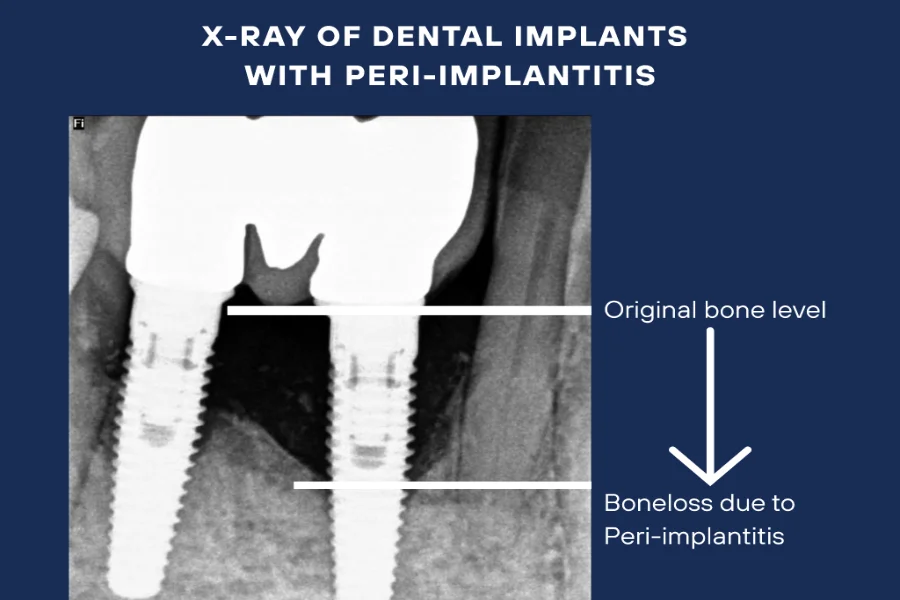
One of the most dangerous things about peri-implantitis is that, like gum disease, it's often painless until it's advanced. Many patients don't feel anything is wrong until the implant is already in serious trouble. That's why knowing the warning signs — and acting on them early — is so important.
Watch for:
If you notice any of these — especially bleeding around the implant — don't wait. Early evaluation is the difference between a simple professional cleaning and a fight to save the implant.
Learn more: Peri-Implantitis Treatment at Council Oak Perio
Peri-implantitis is driven primarily by bacterial biofilm — the same plaque that causes gum disease — accumulating around the implant. But several risk factors make it significantly more likely, and understanding them is the key to prevention.
Poor oral hygiene. The single biggest controllable risk factor. Plaque left to accumulate around an implant is what starts the entire process. Studies have found poor oral hygiene dramatically increases the odds of peri-implant disease.
A history of periodontal (gum) disease. Patients who have had gum disease around their natural teeth are at meaningfully higher risk of peri-implantitis. The same susceptibility that affected the teeth applies to the implant — which is why gum disease should be fully controlled before an implant is placed, and monitored carefully afterward.
Smoking. Tobacco compromises blood flow and immune response in the tissues, significantly raising the risk of implant complications and failure.
Uncontrolled diabetes. Poorly managed blood sugar impairs healing and the body's ability to fight infection, increasing peri-implant disease risk.
Inadequate professional maintenance. Implants, like natural teeth, need regular professional monitoring and cleaning. Without it, early problems go undetected until they've become serious.
Treatment depends heavily on the stage — which, again, is why early detection matters so much.
For peri-implant mucositis (the reversible stage), treatment is typically non-surgical: professional cleaning to remove plaque and calculus from around the implant, along with reinforced home care. Because no bone has been lost, thorough decontamination and improved daily cleaning can return the tissue to health.
For peri-implantitis (the advanced stage), treatment is more involved. The goals are to stop the infection, thoroughly decontaminate the implant surface, and, where possible, regenerate lost bone. This may include:
As a periodontist, Dr. Bingham is specifically trained in the surgical and regenerative procedures used to treat advanced peri-implantitis — the same expertise used to treat bone loss around natural teeth. This is a significant advantage of having implants managed by a periodontist: the specialist who understands how to save teeth from bone loss is the one best equipped to save implants from it too.
Learn more: Peri-Implantitis Treatment at Council Oak Perio
The best treatment for peri-implantitis is preventing it in the first place. The good news is that prevention is highly effective and largely within your control:
An implant is a significant investment in your health and your smile. Protecting it isn't complicated — it's consistent daily cleaning plus regular professional monitoring. Done well, a properly cared-for implant can last for decades.
Is peri-implantitis the same as gum disease?
They're very closely related. Peri-implantitis is essentially gum disease occurring around a dental implant instead of a natural tooth — the same bacterial process, causing the same kind of inflammation and bone loss. This is why the specialist who treats gum disease, a periodontist, is also ideally suited to prevent and treat peri-implantitis.
Can peri-implantitis be cured?
It depends on the stage. The early stage, peri-implant mucositis, is reversible and can be fully resolved if caught before bone loss occurs. Once it advances to true peri-implantitis with bone loss, the infection can be stopped and the implant often saved, but bone already lost is difficult to fully recover — which is why early detection is so important.
Will I lose my implant if I have peri-implantitis?
Not necessarily. Many implants affected by peri-implantitis can be saved with prompt, appropriate treatment that stops the infection and, in some cases, regenerates lost bone. The outcome depends largely on how early it's caught and how much bone remains — which is why acting at the first sign, like bleeding around the implant, matters so much.
How do I know if I have peri-implantitis?
The most common early sign is bleeding when you clean around the implant. Other signs include red or swollen tissue, bad breath, recession around the implant, or the implant feeling loose. Because it's often painless early on, the most reliable way to catch it is through regular professional monitoring with your periodontist.
Why should a periodontist manage my dental implants?
A periodontist specializes in the gums and bone that support both natural teeth and implants — including diagnosing and treating the diseases that threaten them. Having your implants placed and monitored by a periodontist means the same specialist who understands bone loss and gum disease is watching over your implant investment, and is equipped to intervene early and surgically if a problem develops.
References:
If you have a dental implant and have noticed bleeding, swelling, or any change around it — or you simply want a specialist monitoring your implant to keep it healthy — we're here to help.
Dr. Christopher Bingham is a board-certified periodontist with over 20 years of experience who both places implants and treats the conditions that threaten them. Not a chain. Not a franchise. Just a specialist and his team, right here in Central Austin since 2013.
Schedule Now
📞 512-453-1600
711 W. 38th St. Suite G5 · Austin, TX 78705
This blog post has been reviewed, edited, and approved by Dr. Christopher Bingham, board-certified periodontist, Austin, Texas.
Saving teeth when we can. Replacing teeth when we must. Creating confident, healthy smiles.™