
By Dr. Christopher Bingham, DDS, MS | Board-Certified Periodontist | Council Oak Perio, Austin, TX
If your dentist has referred you to a periodontist — or if your gums have been bleeding, tender, or slow to heal — you may be wondering what periodontal treatment actually involves. The short answer: treatment happens in three distinct phases, and understanding each one makes the process far less intimidating.
Periodontal disease (gum disease) is a chronic bacterial infection of the gums and bone that support your teeth. At Council Oak Perio in Austin, TX, Dr. Christopher Bingham, board-certified periodontist, treats it with a structured three-phase approach:
Most patients complete Phase 1 and move directly to Phase 3. Understanding why some patients need Phase 2 — and how to avoid it — is one of the most important things you can know going into treatment.
The goal of every phase is the same: clean the root surfaces below the gum line so completely that the body can heal itself. With the right treatment and ongoing care, most patients can keep their natural teeth for life.
Scaling and root planing (SRP) — sometimes called a "deep cleaning" — is a non-surgical procedure that removes plaque, tartar (calculus), and bacteria from root surfaces below the gum line. A regular cleaning only addresses what's above and just at the gumline. SRP goes deeper, into the pockets that form between your teeth and gums when disease is present.
Two elements are required for periodontal disease to develop: pathogenic bacteria and a susceptible host. In a diseased periodontal pocket, bacteria colonize in layers. It is the most destructive bacteria in the deepest layer — including F. nucleatum, P. gingivalis, and T. forsythia — that trigger the immune response causing gum tissue and bone loss. SRP disrupts and removes these bacteria, giving your immune system the chance to resolve the infection.
According to the European Federation of Periodontology (EFP) 2020 S3 Clinical Practice Guideline — developed by 90 experts across 19 countries, synthesizing 15 systematic reviews — SRP is the evidence-based first-line treatment for Stages I through III periodontitis (mild to severe gum disease).
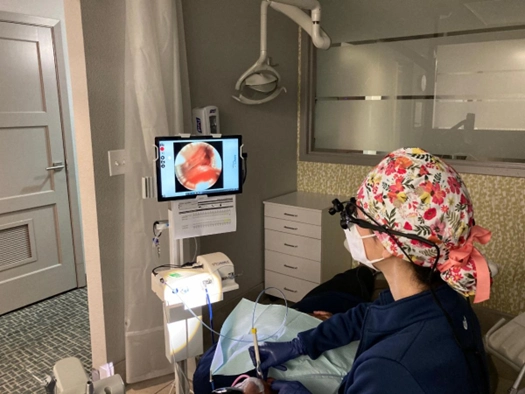
At Council Oak Perio, we use a dental endoscope — a tiny fiber-optic camera attached to a periodontal probe — that allows our hygienists to see below the gum line in real time as they clean. Traditional SRP is a blind procedure: at a probing depth of 5mm, it is only 30–40% effective at removing calculus. With visual SRP, we can be close to 100% effective, because our hygienists can see every deposit and confirm it has been completely removed before moving on.
Allie, our endoscope-trained hygienist, described it this way: "I never knew what I was missing before using an endoscope. And for me, there is no going back."
A successful Phase 1 achieves the following measurable outcomes:
A step that many practices skip — and that the EFP guidelines specifically recommend — is a re-evaluation appointment at 4–6 weeks after SRP to measure whether these goals have been met. Without it, patients are often moved to surgery unnecessarily, or left cycling through repeated rounds of SRP that never fully resolve the disease.
At Council Oak Perio, patients typically transition to periodontal maintenance appointments every three months following SRP. For most patients, we follow this schedule for approximately one year before making an assessment about next steps. This gives the body the time it needs to heal and continue repairing the damage caused by periodontal disease. Our goal is to follow you closely during that first year of therapy to ensure you are healing well and moving in the right direction — because the body is remarkably capable of healing itself when the source of infection has been completely removed.
Most patients respond well to Phase 1 and move directly to Phase 3 (maintenance). Some experience significant improvement in as little as 6–8 weeks. The body is remarkably good at healing itself once the source of infection is completely removed.
Since introducing the dental endoscope at Council Oak Perio, we have observed an almost 50% reduction in the number of patients requiring pocket-reduction surgery after visual SRP. That is better for patients — less cost, less discomfort, faster recovery.
Patients who, after SRP re-evaluation, still show probing depths of 5mm or greater, persistent bleeding on probing, or minimal improvement in pocket depth are candidates for Phase 2.
Learn more: Endoscopic Periodontal Treatment
In some patients, even thorough SRP cannot fully resolve the disease. This happens when chronic inflammation has irregularly destroyed the bone supporting the teeth, leaving deep pockets — 5mm or greater — that bacteria simply repopulate after each cleaning. When the anatomy of the bone itself is the problem, surgery is necessary to address it directly.
This is not a failure of Phase 1. It is an accurate diagnosis: some patients' bone loss has progressed to a point where no amount of cleaning from above can eliminate the pockets. Surgery allows Dr. Bingham to access the bone directly, remove all remaining infection, and reshape or rebuild the bone so the area can be properly maintained long-term.
Dr. Bingham performs anatomic periodontal surgery using two approaches, depending on what the bone anatomy allows:
In many cases, Dr. Bingham uses both techniques during the same procedure, using bone grafting where the anatomy supports it and resection elsewhere. Anatomic periodontal surgery is one of the most technically demanding procedures in periodontics — it requires both surgical skill and nuanced clinical judgment about what each area of the mouth can realistically achieve.
Surgery is performed under local anesthesia. For patients with dental anxiety, sedation is available. Most patients return to normal activity within 24–48 hours. A re-evaluation at 4–6 weeks after surgery confirms whether probing depths have resolved before beginning Phase 3.
Learn more: Gum Disease Treatment at Council Oak Perio
Periodontal disease is a chronic condition — similar to diabetes or high blood pressure in this important way: it can be controlled, but it cannot be cured. Without consistent, professional maintenance, the disease will return. Research shows that patients who receive professional periodontal maintenance every three months have significantly better long-term outcomes — less bone loss, fewer teeth lost — than those who return to twice-yearly standard cleanings.
Periodontal maintenance is not the same as a regular cleaning. It is a therapeutic appointment designed to keep the bacterial environment in your mouth stable so that the gains made in Phases 1 and 2 are preserved.
Each of our maintenance visits follows a five-step protocol chosen specifically for its evidence base — not simply because it is standard practice:
Maintenance visits are typically every three months, often alternating between our office and your general dentist for continuity. Your frequency may be adjusted over time based on how stable your condition remains.
The best maintenance visit in the world cannot compensate for poor home care. The fundamentals matter more than most patients realize:
Repeated SRP without a 4–6 week re-evaluation is one of the most common reasons patients cycle through treatment without resolution. Research is clear that multiple rounds of SRP are no more effective than a single well-executed round. If traditional SRP hasn't resolved your gum disease, two things may be missing: a proper re-evaluation to assess what's left and the visual tools to see and remove what conventional instruments missed. This is precisely what the dental endoscope addresses.
Not necessarily. Many patients with significant disease — including those with deep pockets and bone loss — respond well to Phase 1 alone, especially with visual SRP. Surgery is only recommended after a proper 4–6 week re-evaluation confirms that Phase 1 has not achieved its clinical objectives. Since introducing the dental endoscope, pocket reduction surgery at Council Oak Perio has decreased by almost 50%.
The EFP guidelines recommend every three months for patients with a history of periodontitis. We typically alternate visits between our office and your general dentist. Frequency may be adjusted over time based on how stable your condition remains.
Yes. Research links periodontal disease to heart disease, stroke, diabetes, Alzheimer's disease, respiratory problems, and adverse pregnancy outcomes. The bacteria responsible for gum disease can enter the bloodstream and affect the entire body. Treating gum disease is not just about your mouth — it is a meaningful part of protecting your overall health.
Dr. Bingham offers twilight IV sedation. Sedation is generally not covered by dental insurance. A driver is required for oral conscious and IV sedation appointments.
If your gums have been bleeding, you have been told you need a deep cleaning, or you are frustrated by gum disease that keeps coming back — we are here to help.
Dr. Christopher Bingham is a board-certified periodontist with 20+ years of experience who takes the time to explain exactly what is happening in your mouth and why, so you can make informed decisions about your care. Not a chain. Not a franchise. Just a specialist and his team, right here in Central Austin since 2013.
Schedule Now
📞 512-453-1600
711 W. 38th St. Suite G5 · Austin, TX 78705
This blog post has been reviewed, edited, and approved by Dr. Christopher Bingham, board-certified periodontist, Austin, Texas.
Saving teeth when we can. Replacing teeth when we must. Creating confident, healthy smiles.