
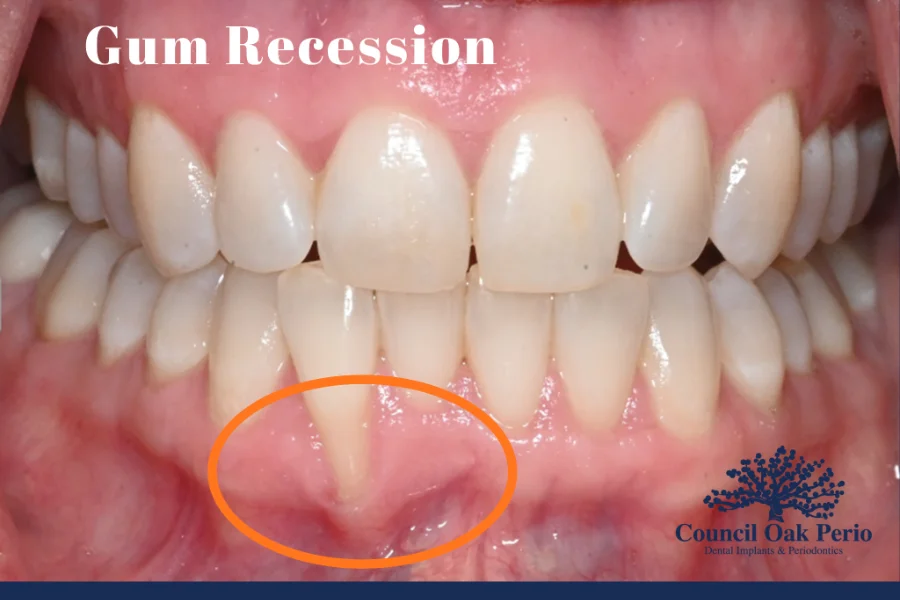
By Dr. Christopher Bingham, DDS, MS | Board-Certified Periodontist | Council Oak Perio, Austin, TX
If you're asking this question, you've probably noticed your gums pulling back — and you're worried about where it ends. So here's the honest answer up front: teeth do not fall out from gum recession alone. What actually causes tooth loss is the combination of recession and the loss of the bone that anchors your teeth. As a general guide, recession of 5mm or more accompanied by significant bone loss is the danger zone where teeth can loosen and eventually be lost — but a tooth with healthy bone support can tolerate visible recession for years without ever becoming loose.
That distinction matters enormously, because it means the amount of recession you can see in the mirror doesn't tell the whole story. What determines whether your teeth are truly at risk is what's happening below the gumline — the bone support and how that tooth is positioned in the jaw. That can only be measured with a proper periodontal exam. At Council Oak Perio in Austin, TX, Dr. Christopher Bingham, a board-certified periodontist with over 20 years of experience, measures the recession, the underlying bone, and the position of the tooth to give patients a clear, honest picture of where they actually stand.
If your gums are receding, this post will help you understand the stages, the real warning signs that teeth are in danger, and — most importantly — why recession caught at almost any stage can be stopped.
Your teeth are not held in place by your gums. They're anchored in your jawbone, secured by a network of fibers called the periodontal ligament. The gums act as a protective seal around this foundation — covering the roots, keeping bacteria out, and shielding the structures underneath.
When gums recede, that seal is compromised. The exposed root becomes more sensitive and prone to decay, and the area becomes harder to keep clean. But the tooth itself remains firmly anchored — as long as the bone beneath is intact.
The real threat emerges when the cause of the recession is also destroying bone. This is most often periodontal disease: a bacterial infection that not only pushes the gums back but also actively eats away at the bone that holds your teeth. When recession is paired with progressive bone loss, the tooth's foundation shrinks. With enough bone loss, the tooth loosens. That — not the receding gumline itself — is how teeth are ultimately lost.
This is why two patients with identical-looking recession can be in completely different situations: one has recession from overbrushing with full bone support and stable teeth, while the other has recession from gum disease with serious bone loss underneath. In the mirror, they look the same. Under a periodontal probe and an X-ray, they are worlds apart.
Learn more: Gum Recession Treatment at Council Oak Perio
There's another factor that the mirror can't reveal: where your tooth actually sits in the jaw. Tooth position plays a significant role in both why recession occurs and how much risk it carries.
Teeth that are crowded, tilted, rotated, or positioned toward the outer edge of the jaw naturally have thinner bone and gum tissue covering their roots to begin with. When a tooth sits outside the ideal envelope of bone, there's simply less foundation there — sometimes the bone covering the root is paper-thin or, in places, already absent before any disease is involved. On these teeth, recession tends to occur more readily, and because the underlying support was thinner from the start, there's less margin before the tooth's stability is affected. This is why you'll sometimes see significant recession isolated to just one or two teeth while the rest of the mouth looks healthy — those specific teeth are positioned in a way that leaves them more exposed.
The practical takeaway: the same 3mm of recession can mean very different things on two different teeth. On a well-positioned tooth with generous bone support, it may be stable and low-risk. On a crowded or prominently positioned tooth with naturally thin support, that same measurement warrants closer attention. Reading that difference is exactly what a periodontal evaluation is for — and in some cases, addressing the position itself, sometimes in coordination with an orthodontist, is part of protecting the tooth long-term.
Learn more: Gum Recession Treatment: Every Option Explained, From Watchful Waiting to Gum Grafts
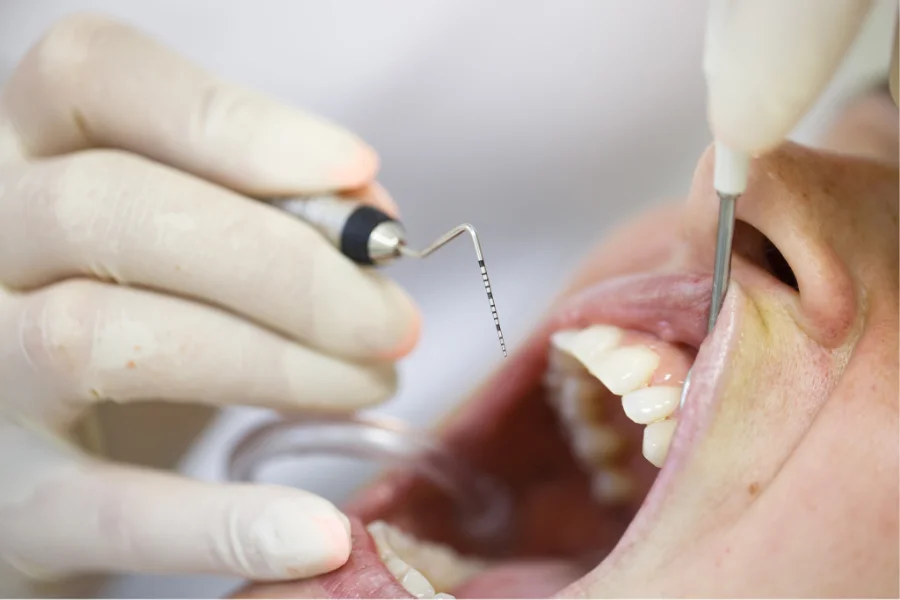
Recession is measured in millimeters from where the gumline should sit. Here's how the stages generally break down — and what each means for your teeth.
At this stage, a recession is often unnoticeable without close scrutiny. You might have slight sensitivity or notice your teeth looking a touch longer. Tooth loss risk: essentially none at this stage. The priority is identifying the cause — brushing habits, tooth position, grinding, early gum disease — and stopping it, so the recession never advances. Caught here, recession is very manageable and may need nothing more than a corrected habit and monitoring.
Root surfaces are now visibly exposed. Sensitivity to cold is common, and the exposed roots are more vulnerable to decay — including cavities at the gum line. Pockets may be forming between the teeth and gums, harboring bacteria that accelerate tissue and bone damage. Tooth loss risk: still low if bone support is healthy — but this is the stage where professional evaluation and treatment matter most, because intervention here can prevent the progression to severe recession entirely. On a poorly positioned tooth with naturally thin support, this stage warrants closer attention. Gum grafting is often appropriate here to cover roots and rebuild the protective tissue.
A significant portion of the root is exposed, and — critically — recession this advanced is frequently accompanied by bone loss, especially when periodontal disease is the cause. Teeth may begin to feel loose, shift position, or develop widening gaps. This is the stage where tooth loss becomes a genuine risk. Even here, though, teeth can often be saved: treatment can stop the disease driving the bone loss, grafting can restore protective tissue, and regenerative procedures can in some cases rebuild a portion of the lost bone. Severe recession is urgent — but it is not hopeless.
Because the visible gumline doesn't tell the whole story, watch for the signs that indicate the foundation is being affected — these are the signals that mean it's time to see a periodontist promptly:
If you're noticing any of these alongside recession, don't wait to see how it develops. The earlier the underlying disease is treated, the more bone — and the more teeth — are preserved.
Learn more: Gum Recession Treatment at Council Oak Perio
Here's what often gets lost in the anxiety around this question: gum recession is one of the most treatable problems in dentistry — if you act on it.
The cause can be stopped. Whether it's brushing technique, tooth position and bite, grinding, or periodontal disease, identifying and treating the cause halts the progression. For gum disease specifically, treatment like scaling and root planing removes the infection driving both the recession and the bone loss.
Lost gum tissue can be restored. While gums don't grow back on their own, a gum graft can cover exposed roots, eliminate sensitivity, rebuild the protective seal, and protect the tooth for life. Dr. Bingham performs grafting with platelet-rich fibrin (PRF) and a custom palatal stent to make recovery as comfortable as possible.
Even bone can sometimes be rebuilt. In select cases, regenerative procedures can restore a portion of the bone lost to periodontal disease, strengthening the foundation of at-risk teeth.
The one thing that can't be recovered is time. Every month, recession and bone loss progress untreated; there is less tissue and less bone to work with. The difference between catching this at 2mm versus 6mm is the difference between a simple corrected habit and a fight to save the tooth.
Learn more: Gum Recession Treatment: Every Option Explained
How much gum recession is normal? Small amounts of recession become common with age — roughly 88% of people over 65 have recession on at least one tooth. But "common" isn't the same as "harmless." Any visible recession is worth having evaluated, because the goal is to identify the cause and stop it while intervention is simple.
Will my teeth fall out if my gums are receding? Not from recession alone. Teeth are anchored by bone, and they only become loose when that bone is lost — usually to periodontal disease. If your recession is caught and its cause treated while your bone support is healthy, your teeth are not in danger of falling out. This is exactly what a periodontal exam determines.
Does the position of my teeth affect my recession risk? Yes. Teeth that are crowded, tilted, or positioned toward the outer edge of the jaw naturally have thinner bone and gum covering their roots, which makes them more prone to recession and can mean less margin before stability is affected. This is why recession is sometimes concentrated on just one or two teeth. A periodontist evaluates tooth position along with bone support to judge the true risk — and in some cases, correcting the position is part of the solution.
How fast do gums recede? It varies widely by cause. Recession from brushing, tooth position, or grinding typically progresses slowly, over years. Recession driven by active periodontal disease can move much faster, because the infection is simultaneously destroying gum and bone. Rapid or noticeably progressing recession is a sign to be evaluated promptly.
Can teeth loosened by gum recession and bone loss be saved? Often, yes. Treating the underlying periodontal disease stops further bone loss, and regenerative and grafting procedures can rebuild support in many cases. The outcome depends heavily on how much bone remains — which is why acting at the first sign of looseness matters so much.
If your gums are receding and you're wondering how serious it is, the answer is measurable — and knowing is far better than worrying.
Dr. Christopher Bingham is a board-certified periodontist with over 20 years of experience who will measure exactly where you stand — the recession, the bone support, the position of the tooth, and the cause — and explain your real options honestly. Not a chain. Not a franchise. Just a specialist and his team, right here in Central Austin since 2013.
711 W. 38th St. Suite G5 · Austin, TX 78705
This blog post has been reviewed, edited, and approved by Dr. Christopher Bingham, board-certified periodontist, Austin, Texas.
Saving teeth when we can. Replacing teeth when we must. Creating confident, healthy smiles.™