By Dr. Christopher Bingham, DDS, MS | Board-Certified Periodontist | Council Oak Perio, Austin, TX
You can do a great deal about gum recession without surgery. You can stop it from getting worse, protect the exposed roots, calm the sensitivity, and improve the health of the tissue you still have. What you cannot do without surgery is regrow gum tissue that is already gone.
That distinction is the honest heart of this topic, and most articles avoid stating it plainly. So here it is: once gum tissue has receded, it does not grow back on its own, and no toothpaste, rinse, supplement, or natural remedy will bring it back. What non-surgical treatment does is arrest/stop the problem and manage its effects, which for many patients with mild recession is exactly enough. At Council Oak Perio in Austin, TX, Dr. Christopher Bingham, a board-certified periodontist with over 20 years of experience, will tell you honestly which category you fall into, rather than sell you a fix that cannot work.
This post explains what non-surgical treatment genuinely accomplishes, walks through the six causes that must be addressed first, names the remedies that do not work, and tells you when surgery becomes the right choice.
Set your expectations correctly, and non-surgical treatment can serve you well. Misunderstand it, and you may let recession advance while waiting for a cure that is not coming.
What it can do:
What it cannot do:
Understanding this tells you the real goal of non-surgical care: not to turn back the clock, but to stop it. When recession is caught early, and its cause is corrected, stopping it is often all you need.
Every effective plan begins the same way, by identifying what is driving the recession. Treat without addressing the cause, and the recession simply continues.
Dr. Bingham points to six causes of gum recession. Each calls for a different response.
As teeth erupt or are moved through orthodontic treatment, a root can end up positioned toward the cheek or the lip rather than centered in the bone. That position stretches the gum tissue over the root, and as the tissue stretches, it exposes part of the root.
What can be done? While repositioning the tooth(or teeth) can be done, often it is time-consuming and expensive. When this isn’t possible, gum grafting often can reduce or minimize root exposure.
Not all gum tissue is the same. Thick, firm, bound-down tissue resists recession well. Thin, weak tissue is far more inclined to recede, and often does so with little provocation.
What can be done. This one deserves an honest answer: tissue type is an anatomical trait, and no non-surgical measure changes it. What you can do is protect thin tissue diligently, remove every other stress on it, and monitor it closely so that any recession is caught immediately. When thin tissue continues to recede, grafting is the only way to build the thicker, more durable tissue that will hold.
Trauma reaches the gumline in several forms. Heavy plaque accumulation over an extended period is one. Physical injury from something as ordinary as a sharp tortilla chip is another. And one of the most common, and most overlooked, is abrasive toothpaste.
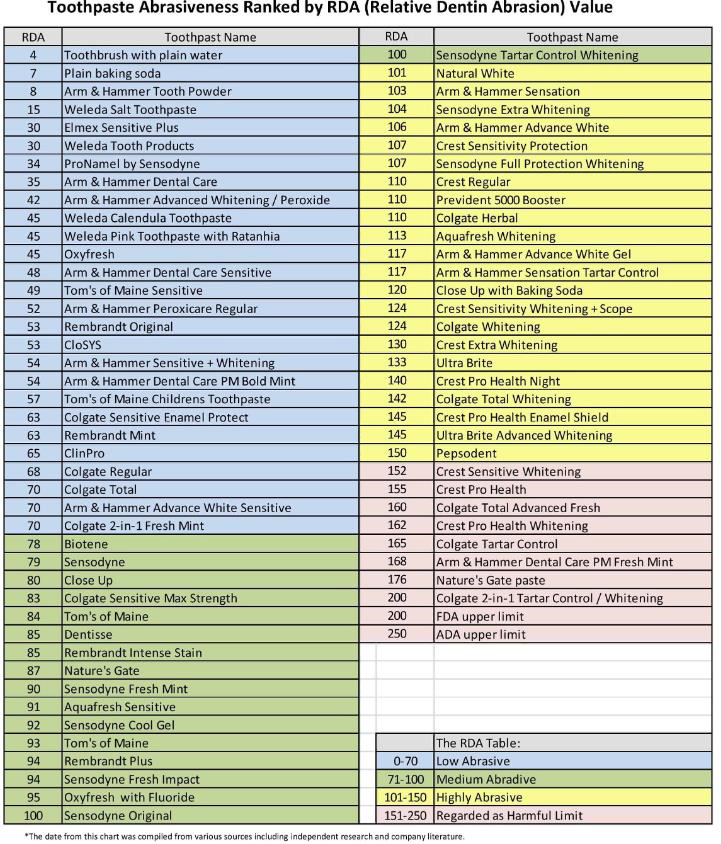
Toothpastes vary enormously in how abrasive they are. The measure is called RDA, or Relative Dentin Abrasion, and it runs from about 4 for a toothbrush with plain water to 250 at the upper limit the American Dental Association permits. Anything at 70 or below is considered low abrasion. Above 100 is highly abrasive. Used twice a day over years, a highly abrasive paste wears away gum tissue and tooth structure.
Two facts surprise most patients. Whitening formulas are often more abrasive and can remove healthy gum and tooth structure. Even a toothpaste marketed for sensitive teeth is not automatically gentle: some sensitivity formulas measure over 150, well into the range considered harmful, even as they soothe the nerve inside the tooth.
None of this is printed on the box. That is the problem.
What can be done. Switch to a low-abrasion toothpaste. Dr. Bingham keeps a ranked table of toothpaste RDA values and reviews it with patients, because the differences between products are large and impossible to judge from the packaging. Alongside that, improve plaque control with consistent daily cleaning, and be mindful of sharp, hard foods at a vulnerable gumline. For recession driven by trauma, switching to a gentler toothpaste alone often stops it.
A frenum is a soft-tissue attachment the body forms to connect the lips and cheeks to the jawbone. When a frenum attaches close to the gumline, it tugs and pulls the tissue away from the tooth every time the lip moves, and recession follows.
What can be done. Releasing the frenum removes the pull. This is a minor procedure rather than a purely non-surgical measure, but it is small, quick, and addresses a cause no toothpaste or technique can touch. It is a specific finding a periodontist is trained to spot, and one that generic advice about brushing will never resolve.
Restorative dentistry can contribute to recession. A filling or crown margin at or below the gumline can irritate the tissue and drive it back.
What can be done. When restorative work is the culprit, adjusting or replacing it removes the irritation. This is usually coordinated with your general dentist, who can refine the edge of the restorative material so the tissue is no longer stressed.
6. Gum disease
Gum disease is a bacterial infection, and it differs from every other cause on this list in two ways that matter. It is active and progressive, so it worsens on its own until it is treated. And it destroys not just gum tissue but the bone underneath, which is what anchors your teeth. Bacteria collect below the gumline and provoke chronic inflammation. As that inflammation breaks down the attachment and bone around a tooth, the gums recede along with them. Recession from gum disease also tends to affect several teeth rather than one, and it usually comes with other signs: bleeding when you brush, tenderness, swelling, or persistent bad breath (halitosis).
What can be done. This is the cause where non-surgical treatment accomplishes the most. Scaling and root planing, a deep cleaning performed below the gumline, removes the bacteria and hardened deposits driving the inflammation. At Council Oak Perio, we perform SRP with a dental endoscope, so our hygienists can see the root surface as they clean rather than working by feel. Once the infection is fully removed, the recession stops, the inflammation resolves, and the tissue often reattaches to the clean root surface. A re-evaluation four to six weeks later confirms whether treatment achieved its goals. One caveat belongs here: non-surgical treatment can halt the disease, but bone already lost does not come back. That is the strongest argument for treating gum disease early rather than watching it.
Watch: Dr. Bingham explains the causes of gum recession. Learn more.
Once the cause is under control, non-surgical treatment turns to protecting the exposed roots and easing discomfort.
Desensitizing toothpaste. These work in two different ways. Potassium nitrate calms the nerve inside the tooth. Stannous fluoride and nano-hydroxyapatite instead seal the microscopic channels in the exposed root that carry sensation to that nerve. Nano-hydroxyapatite is worth knowing about: it is the mineral your teeth are largely built from, and several systematic reviews have found it reduces sensitivity at least as well as fluoride, with some evidence that it acts faster in the first few weeks of use. None of these reverse recession, but used consistently over several weeks, they can meaningfully reduce sensitivity.
Varnish and gels. Applied in the office or prescribed for home, these strengthen the exposed root surface, guard against the decay that exposed roots are prone to, and reduce sensitivity.
Dental bonding. For small areas of exposed root, a tooth-colored composite can be bonded over the surface to cover it and reduce sensitivity. It is a reasonable option in select cases, though it covers the root rather than restoring the gum.
Professional maintenance. Regular cleanings keep the gumline healthy, control the plaque accumulation that causes trauma, and let us monitor the recession so we catch progression early.
If you search for ways to regrow gums, you will find oil pulling, aloe, green tea, essential oils, and various supplements promoted as cures. Be skeptical.
No natural remedy regrows lost gum tissue. The American Academy of Periodontology and the available clinical evidence do not support these claims. Some practices, like oil pulling, may modestly reduce plaque, which helps in a small way, but none restore tissue that has receded, and none should replace brushing, flossing, and professional care.
The real risk is not that these remedies fail. The real risk is that trusting them wastes time. While you wait for gums to regrow, the recession quietly advances, and a problem you could have stopped becomes one that requires surgery.
Non-surgical care is the right first step for mild recession with a correctable cause. Surgery becomes the better choice when:
In these cases, a gum graft is the only way to physically restore the gumline, cover the exposed root, and protect the tooth long term. This is not a failure of non-surgical care. It means the recession has passed the point where stopping it is enough, and the tissue needs to be rebuilt.
Dr. Bingham performs grafting with a comfort-focused protocol, using platelet-rich fibrin and a custom stent to ease healing. The point is not to push every patient toward surgery, but to be honest about when it is genuinely the right answer, and when it is not.
Learn more: Gum Recession Treatment: Every Option Explained
Can you fix gum recession without surgery? You can stop it, protect the exposed roots, and manage sensitivity without surgery, and for mild recession that is often all you need. What you cannot do without surgery is regrow lost gum tissue. Non-surgical care halts the problem; only a gum graft restores tissue that has already receded.
Can gums grow back naturally? No. Once gum tissue recedes, it does not grow back on its own, and no toothpaste, rinse, supplement, or natural remedy will restore it. Non-surgical treatment stops further loss and improves the health of the gum you still have, but restoring lost tissue requires a graft.
Does desensitizing toothpaste fix receding gums? It treats the symptom, not the recession. Toothpaste with potassium nitrate or stannous fluoride reduces the sensitivity of exposed roots over several weeks of regular use. It is genuinely helpful for comfort, but it does not stop recession or restore tissue, so it works best alongside treatment that addresses the cause.
Does oil pulling regrow gums? No. There is no strong evidence that oil pulling regrows or reverses gum recession. It may slightly reduce plaque, but it cannot restore lost tissue and should never replace brushing, flossing, and professional care. Relying on it can allow recession to advance untreated.
How do I stop gum recession from getting worse? Find the cause and address it. Dr. Bingham points to six: tooth position, the type of gum tissue you have, trauma from plaque or aggressive brushing, a frenum pulling on the gumline, fillings or crowns irritating the tissue, and gum disease. Some are corrected simply; others, like thin tissue or a frenum, need a periodontist to identify and manage. Regular monitoring catches progression early.
If your gums are receding, the best first step is finding out what is causing it and whether you can stop it without surgery. Often, you can.
Dr. Christopher Bingham is a board-certified periodontist with over 20 years of experience who will give you an honest assessment, not an upsell. Not a chain. Not a franchise. Just a specialist and his team, right here in Central Austin since 2013.
📞 512-453-1600
711 W. 38th St. Suite G5
Austin, TX 78705
This blog post has been reviewed, edited, and approved by Dr. Christopher Bingham, board-certified periodontist, Austin, Texas.
Saving teeth when we can. Replacing teeth when we must. Creating confident, healthy smiles.™